

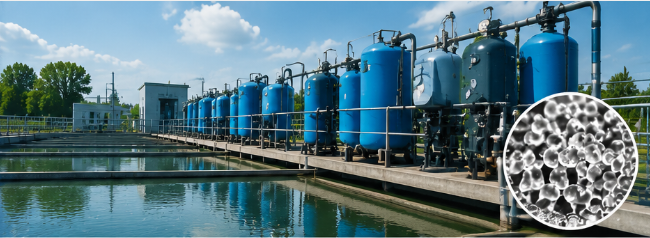
Choosing the right filter media is an important part of designing an effective water filtration system. Particle size, particle shape, media structure, and operating conditions can all influence how water flows through a filter bed and how suspended particles are retained.
Glass is used in various filtration applications because it can be manufactured in different particle sizes and forms. However, not all glass media are the same. Spherical glass beads and crushed glass filter media have different physical characteristics and should be evaluated according to the requirements of the filtration system.
In this guide, we explain the key factors to consider when selecting glass media for water filtration and what information buyers should prepare before contacting a manufacturer.
1. Understanding Glass Media in Water Filtration
Glass media can be used in different types of water treatment and filtration systems. Depending on the design, it may serve as a filtration medium, a support material, or part of a specially designed filter bed.
The physical characteristics of the media affect how particles are arranged within the filter bed and how water passes through it.
When evaluating glass media, buyers should first understand the difference between the main product forms:
- Spherical glass beads: Manufactured particles with a rounded shape and relatively consistent geometry.
- Crushed glass filter media: Processed glass particles with irregular shapes and angular surfaces.
These materials should not be treated as interchangeable. Their particle arrangements, flow characteristics, and filtration behavior can differ.
The most suitable option depends on the filter design, target contaminants, required filtration performance, and operating conditions.
2. Spherical Glass Beads vs. Crushed Glass Filter Media
One of the first questions buyers should consider is whether their application requires spherical particles or irregular glass media.
| Feature | Spherical Glass Beads | Crushed Glass Filter Media |
|---|---|---|
| Particle shape | Rounded and spherical | Irregular and angular |
| Particle geometry | More consistent | Varies with crushing and screening |
| Surface structure | Generally smooth | Often has angular surfaces |
| Particle arrangement | Influenced by spherical packing | Influenced by irregular particle shapes |
| Typical consideration | Applications requiring controlled particle geometry | Filter beds designed for granular filter media |
Spherical Glass Beads
Spherical glass beads have a rounded shape and can be manufactured within specified particle size ranges.
Their relatively consistent geometry may be useful in technical applications where particle shape and dimensional consistency are important.
However, spherical particles can pack differently from angular filter media. The resulting void spaces, pressure drop, and particle retention characteristics depend on bead size, size distribution, bed depth, and system design.
Therefore, spherical glass beads should be evaluated through application-specific testing before being selected for a particular filtration system.
Crushed Glass Filter Media
Crushed glass filter media is produced by processing glass into irregular particles and separating them into different size grades.
Its angular particle shape creates a different packing structure compared with spherical beads.
This type of material is used in certain granular filtration systems. Its suitability depends on particle size, shape, cleanliness, mechanical properties, and the design requirements of the filter.
Important: A spherical shape does not automatically mean better filtration performance. The correct media should be selected according to the actual filtration process.
3. Key Factors When Selecting Glass Media
Before purchasing glass media for a water filtration system, several technical factors should be evaluated.
3.1 Particle Size and Size Distribution
Particle size is one of the most important specifications when selecting filtration media.
Different particle sizes create different filter-bed structures. They can influence the available flow paths, bed permeability, and particle retention behavior.
Buyers should consider:
- Nominal particle size
- Minimum and maximum particle size
- Particle size distribution
- Permissible oversize and undersize content
A narrow particle size distribution may be important for applications requiring more consistent media geometry.
However, the appropriate size range must be determined by the filtration system design rather than selected independently.
3.2 Particle Shape and Surface Condition
Particle shape influences how glass media arrange themselves within a filter bed.
Spherical beads and angular particles can create different contact points and void structures. These differences may affect water flow and the interaction between suspended particles and the filter bed.
Surface condition is another consideration, particularly where consistent particle geometry and material quality are required.
For technical applications, buyers may need to specify requirements for:
- Sphericity
- Surface condition
- Visible defects
- Particle consistency
These requirements should match the intended function of the glass media.
3.3 Filtration System Design
Glass media should always be selected in relation to the filtration equipment.
Important system parameters include:
- Filter type and configuration
- Filter-bed depth
- Operating flow rate
- Water velocity
- Backwashing requirements
- Target particle retention
- Operating pressure
A particle size that works in one filtration system may not be suitable for another.
For example, changing the media size can affect the flow resistance and packing structure of the filter bed. It is therefore important to evaluate the media together with the system design.
3.4 Chemical Compatibility
The chemical environment of the water is also important.
Buyers should consider the water composition, pH value, dissolved substances, and any chemicals used during treatment.
Glass composition can influence chemical resistance and long-term stability. Different glass formulations may behave differently under specific chemical conditions.
For applications involving aggressive water chemistry or chemical treatment processes, compatibility should be confirmed through appropriate material data or testing.
3.5 Mechanical Strength and Durability
Filter media may experience repeated handling, water flow, backwashing, and contact with other particles.
Mechanical durability is therefore an important selection factor.
Relevant properties may include:
- Resistance to breakage
- Abrasion resistance
- Resistance to particle degradation
- Generation of fines during operation
The required mechanical properties depend on the operating conditions and expected service life of the filtration system.
4. What Specifications Should Buyers Provide?
When contacting a glass media manufacturer, providing clear technical information can help reduce unnecessary communication and improve the accuracy of product recommendations.
The following information is useful:
| Parameter | Information to Provide |
|---|---|
| Application | Drinking water, industrial water, wastewater, or another process |
| Media type | Spherical beads or crushed glass media |
| Particle size | Required nominal size or size range |
| Size distribution | Tolerance or grading requirements |
| Shape requirements | Spherical, angular, or other specifications |
| Water conditions | pH, temperature, and chemical composition |
| System conditions | Flow rate, pressure, and filter configuration |
| Quantity | Estimated order quantity |
| Special requirements | Chemical compatibility, mechanical strength, or other testing needs |
If the application already uses an existing filter medium, providing a sample or technical datasheet can also help clarify the required specifications.
For customized projects, it is particularly useful to understand the customer’s existing filtration process before proposing a material.
5. Custom Glass Media for Water Filtration Applications
Different filtration projects may require different particle sizes, material properties, and quality standards.
At GlassBeadTech, we focus on glass bead manufacturing and customized glass media solutions for industrial and technical applications.
Depending on the project requirements, we can discuss specifications such as:
- Particle size and size distribution
- Glass material and composition
- Spherical geometry requirements
- Surface quality
- Customized production specifications
For applications where filtration efficiency, pressure drop, chemical resistance, or long-term durability are critical, the proposed material should be evaluated under representative operating conditions.
We recommend that customers share their application details, required specifications, and existing material samples whenever possible. This helps establish whether a particular glass media solution is suitable for further development and testing.
6. Frequently Asked Questions
Q1: Can spherical glass beads be used for water filtration?
Spherical glass beads may be considered for certain filtration or technical media applications. However, their suitability depends on particle size, packing structure, filtration system design, and target filtration performance. Testing is recommended before final selection.
Q2: What is the difference between glass beads and crushed glass filter media?
Glass beads have a rounded spherical shape, while crushed glass filter media consists of irregular particles. Their packing structures and flow characteristics can differ, so they should be selected according to the specific filter design.
Q3: How do I choose the correct glass bead size for filtration?
The appropriate particle size depends on the filtration system, target particle retention, flow rate, filter-bed structure, and operating conditions. Buyers should confirm these parameters before specifying the media size.
Q4: Can glass media be customized for industrial filtration projects?
Customization may be possible depending on the required particle size, material, shape, and production conditions. Buyers should provide detailed application requirements so the manufacturer can evaluate the feasibility of the requested specifications.
Conclusion
Selecting glass media for water filtration requires more than choosing a particle size. Particle shape, size distribution, material properties, chemical compatibility, and filtration system design should all be considered together.
Spherical glass beads and crushed glass filter media have different characteristics, and neither should be considered universally suitable for every filtration application.
For buyers developing or improving a filtration system, providing clear technical specifications and operating conditions is the best starting point for identifying an appropriate glass media solution.
Contact GlassBeadTech to discuss your glass media requirements and customized specifications.