

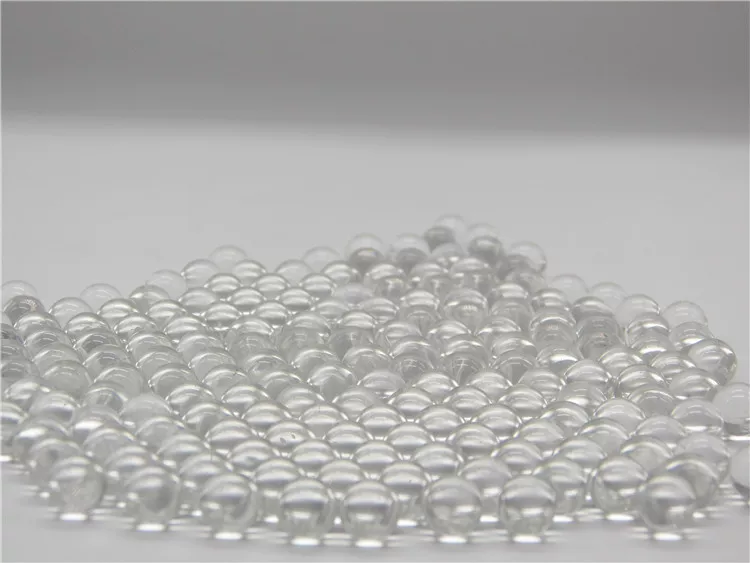
Glass beads are often described by their diameter or particle size range. However, size alone does not provide a complete picture of bead quality.
The shape of a glass bead can also affect its behavior in an industrial process. Roundness and sphericity are important properties in applications where consistent particle movement, surface contact, optical performance or dimensional accuracy is required.
But what do these terms mean, and why should buyers consider them when selecting glass beads?
This article explains the difference between glass bead roundness and sphericity, how bead shape can influence performance, and what to consider when specifying glass beads.
1. What Is Glass Bead Roundness?
Glass bead roundness describes how closely the shape of a bead approaches a perfect sphere.
An ideal sphere has the same radius in every direction. A real glass bead may have small deviations from this ideal shape, depending on its material, manufacturing process and quality control.
These deviations may include:
- Slightly elongated or flattened shapes
- Local surface irregularities
- Small protrusions or uneven areas
- Variations in the bead’s overall contour
For many industrial applications, a generally spherical shape is desirable. In more demanding applications, the degree of deviation from a perfect sphere may need to be controlled.
2. Roundness vs. Sphericity: Are They the Same?
The terms roundness and sphericity are sometimes used interchangeably in commercial descriptions. However, their exact meaning can depend on the measurement method and specification.
In general:
Roundness refers to how closely the outline or contour of a particle approaches a circular or spherical shape.
Sphericity describes how closely the overall three-dimensional shape of a particle approaches a sphere.
For glass beads, both terms relate to particle shape. However, buyers should not assume that a product described as “highly spherical” automatically meets a particular numerical roundness requirement.
If roundness or sphericity is critical, the required definition, acceptance criteria and inspection method should be agreed with the manufacturer.
3. Why Does Glass Bead Shape Matter?
The influence of bead shape depends on the application. A small deviation from a spherical shape may be acceptable in one process but important in another.
Consistent Particle Movement
In applications involving the movement or flow of glass beads, particle shape can influence how beads interact with one another.
More spherical particles may roll more consistently than irregular particles under comparable conditions. However, actual flow behavior also depends on particle size distribution, surface condition, moisture and system design.
Contact and Surface Treatment
For glass beads used in surface treatment, shape can influence the way particles contact a workpiece.
The result also depends on bead size, operating pressure, equipment settings and the material being treated. Roundness should therefore be considered alongside the process conditions rather than as an isolated specification.
Filtration Performance
In filtration systems, bead shape can affect how particles pack together and form spaces between them.
These spaces influence the flow path through a filter bed. However, filtration performance is also affected by bead size distribution, bed design, flow rate and the properties of the fluid.
For this reason, selecting filtration glass beads requires consideration of both particle size and shape.
Optical and Precision Applications
In optical or precision applications, bead shape may be particularly important.
A deviation from a spherical shape can affect how a bead interacts with light or how it behaves in a measurement or positioning system. The importance of this deviation depends on the application and its tolerance requirements.
For precision glass beads, roundness may therefore be specified together with diameter, dimensional tolerance, surface quality and material composition.
4. What Factors Affect Glass Bead Roundness?
The final shape of a glass bead depends on several factors.
Manufacturing Process
The process used to produce glass beads has a direct influence on their shape. Different production methods may be suitable for different bead sizes, materials and quality requirements.
The manufacturing process alone does not guarantee a specific roundness level. Product specifications and inspection results should be considered as well.
Raw Material and Glass Composition
Glass composition can influence the material’s behavior during production.
The appropriate composition depends on the intended application and the required physical or chemical properties.
Particle Size
The required shape control may vary with bead size. A specification suitable for one diameter range may not be directly applicable to another.
Quality Inspection
Inspection is important for confirming whether the finished beads meet the agreed requirements.
Depending on the application, inspection may include particle size measurement, visual examination, image-based analysis or other suitable methods.
When roundness is a critical parameter, buyers should clarify how it is measured and how the results are evaluated.
5. How Should Buyers Specify Glass Bead Roundness?
If your application requires controlled bead shape, it is helpful to provide clear requirements when requesting a quotation.
Consider the following information:
- Application: Describe how the glass beads will be used.
- Particle size: Specify the required nominal diameter or size range.
- Roundness or sphericity: State the required value or acceptance criteria, if available.
- Measurement method: Clarify how the shape requirement should be evaluated.
- Surface quality: Indicate whether surface defects or irregularities are restricted.
- Material composition: Specify any relevant material requirements.
- Inspection documentation: Confirm whether inspection records are required.
A clear specification helps both the buyer and manufacturer understand what needs to be controlled.
If a numerical roundness requirement has not yet been defined, the application and performance expectations can be used as a starting point for discussion.
6. Does Higher Roundness Always Mean Better Glass Beads?
Not necessarily.
Higher roundness may be important in applications that require consistent particle shape. However, it does not automatically mean that a glass bead is the best choice for every application.
Other properties may be equally important, including:
- Particle size and size distribution
- Material composition
- Surface condition
- Chemical resistance
- Mechanical properties
- Cost and availability
The best glass bead specification is the one that meets the actual requirements of the application.
For example, a process that primarily requires a specific particle size range may not need the same roundness control as a precision or optical application.
The goal is to select the appropriate combination of properties rather than focusing on a single quality parameter.
7. Roundness Is One Part of Overall Glass Bead Quality
Glass bead quality should be evaluated through a combination of properties.
Diameter determines the general size of the bead, while particle size distribution describes the variation within a batch. Roundness and sphericity provide information about particle shape. Surface quality and material composition may also affect performance.
For technical applications, these properties should be considered together.
At GlassBeadTech, we supply glass beads for industrial and specialty applications. If your project requires specific particle size, shape or material characteristics, share your application details and quality requirements with our team.
We can discuss the relevant specifications and help identify a suitable glass bead solution.
Contact GlassBeadTech to discuss your glass bead requirements.
Frequently Asked Questions
What is a good roundness value for glass beads?
There is no single roundness value that is suitable for every application. The required value depends on the bead size, intended use and measurement method.
Are all glass beads perfectly spherical?
No. Commercial glass beads may have small deviations from an ideal sphere. The acceptable level of deviation depends on the product specification and application.
Does glass bead roundness affect filtration?
It can. Particle shape may influence how beads pack together and the spaces between particles. Filtration performance also depends on particle size distribution, filter bed design and operating conditions.
Is roundness more important than particle size?
Neither property is universally more important. The relative importance depends on the application. Some processes are primarily sensitive to particle size, while others require closer control of both size and shape.
Can glass bead roundness be inspected?
Yes. Suitable inspection methods can be used to evaluate bead shape. The method and acceptance criteria should be agreed according to the application and required level of precision.