

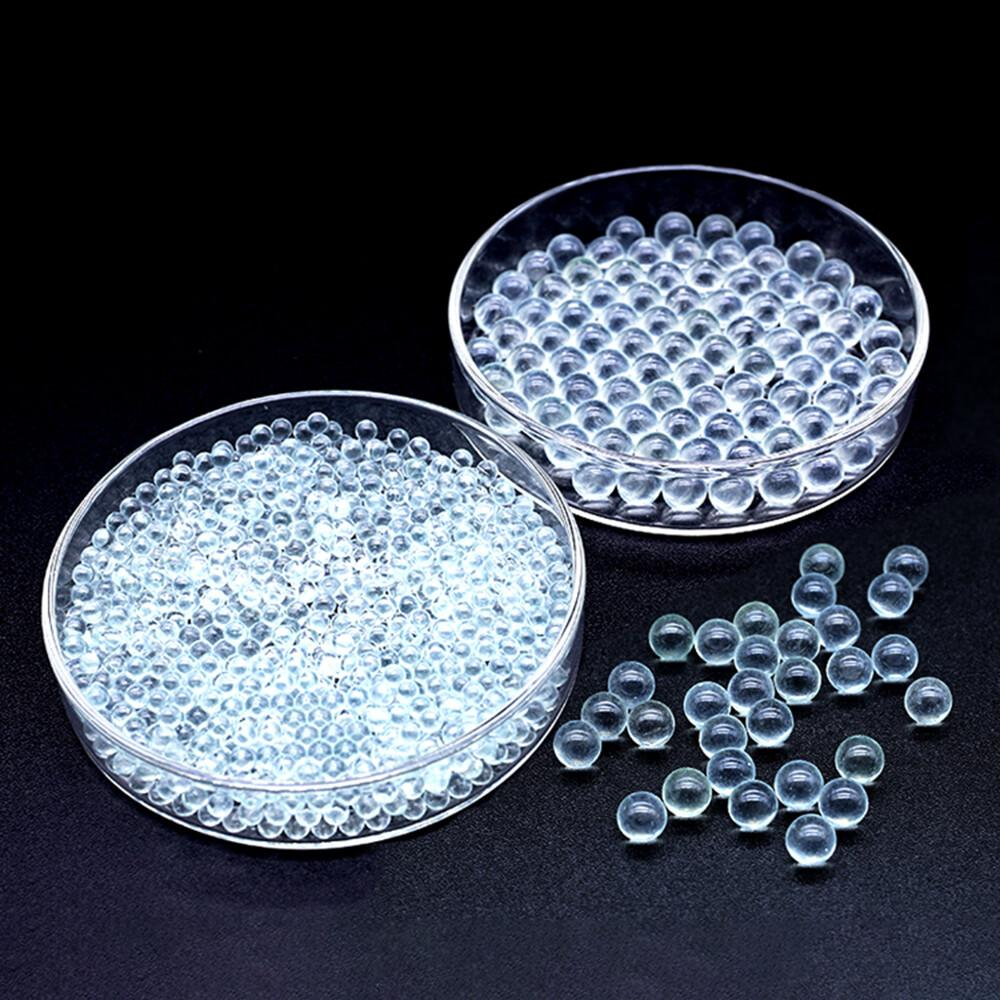
Choosing the right glass bead size is an important part of selecting glass beads for industrial and technical applications. Particle size can affect flow behavior, surface treatment results, filtration performance, optical properties and the consistency of a manufacturing process.
However, there is no single glass bead size that works for every application. The right choice depends on how the beads will be used, the required performance and the specifications of the equipment or process.
In this guide, we explain the key factors to consider when selecting glass bead size and how to avoid common mistakes.
1. Why Does Glass Bead Size Matter?
Glass beads are available in a wide range of particle sizes, from fine particles to larger spherical beads. Even when the material is similar, different sizes can produce different results.
For example:
- Filtration: Particle size affects the void spaces between beads and the flow characteristics of a filter bed.
- Surface treatment: Bead size influences the impact on a surface and the resulting finish.
- Grinding and processing: Particle size affects the contact conditions and behavior of the media.
- Reflective applications: Size distribution and optical properties can influence the performance of reflective materials.
- Precision applications: Diameter consistency and dimensional tolerances may be important for positioning, measurement or other technical requirements.
For this reason, glass bead size should always be selected according to the intended application rather than price or availability alone.
2. Understand the Different Ways Glass Bead Size Is Specified
Before selecting a product, it is important to understand how suppliers describe particle size.
Common specifications include:
Nominal Diameter
The nominal diameter is the stated or target size of a glass bead. For example, a product may be described as having a nominal diameter of 1 mm.
However, this does not necessarily mean every bead measures exactly 1 mm.
Particle Size Range
Many industrial glass beads are supplied within a specified size range.
For example, a size range may be expressed as 0.8–1.2 mm. This indicates the acceptable particle size range, subject to the supplier’s grading and inspection method.
Particle Size Distribution
Particle size distribution describes how the bead sizes are distributed within a batch.
Two products may have the same nominal size but different distributions. One may contain beads concentrated around the target diameter, while another may include a wider range of particle sizes.
For applications that require consistent performance, understanding the distribution can be just as important as knowing the nominal diameter.
Size Tolerance
For precision glass beads, dimensional tolerance may be an important requirement.
A tighter tolerance generally means less variation in bead diameter. The actual tolerance should be confirmed with the manufacturer because it depends on the material, production process, bead size and inspection method.
3. Consider Your Application Before Choosing a Size
Different applications have different requirements. The following points can help narrow down the appropriate size range.
Glass Beads for Filtration
In filtration systems, glass beads may be used as filter media or as part of a filter bed.
Important considerations include:
- Required filtration performance
- Filter bed design and depth
- Water flow rate
- Pressure drop
- Particle size distribution
- Compatibility with the filtration system
A larger or smaller bead size can change the spaces between particles and affect water flow through the bed.
It is therefore important not to select filtration glass beads based on diameter alone. The filter design and operating conditions should also be considered.
Glass Beads for Surface Treatment
Glass beads used for blasting and surface treatment are selected according to the material being treated and the desired surface finish.
Fine beads may be suitable for certain finishing requirements, while larger beads may be selected for different surface treatment conditions.
The appropriate size also depends on equipment settings, operating pressure and the sensitivity of the workpiece.
Glass Beads for Grinding and Processing
For grinding and processing applications, bead diameter affects the contact conditions between the media and the material being processed.
Selection may depend on:
- Equipment type
- Material characteristics
- Required processing result
- Operating speed
- Media wear and service life
The best size should be determined through the requirements of the process and, where necessary, practical testing.
Glass Beads for Precision and Laboratory Applications
Precision glass beads are used in applications where bead diameter, roundness and surface quality may need closer control.
For these applications, buyers should consider more than the nominal diameter. They may also need to specify:
- Diameter and dimensional tolerance
- Roundness or sphericity
- Surface condition
- Glass composition
- Inspection requirements
- Batch consistency
The required level of precision depends on the equipment and intended use.
4. Other Factors That Affect Glass Bead Selection
Size is important, but it is not the only factor that determines whether a glass bead is suitable.
Material Composition
Different glass compositions have different physical and chemical characteristics.
Depending on the application, buyers may need to consider chemical resistance, density, hardness, refractive index or other material properties.
The material should be selected according to the actual operating environment.
Roundness and Surface Quality
For applications that rely on consistent particle behavior or optical performance, bead shape and surface condition can be important.
A specified diameter does not automatically guarantee good roundness or a smooth surface. These properties should be evaluated separately when they matter to the application.
Required Consistency Between Batches
For regular production or long-term supply, batch-to-batch consistency should also be considered.
Buyers should clarify how the supplier controls particle size, how products are inspected and whether inspection records can be provided.
5. A Practical Checklist Before Ordering Glass Beads
Before sending an inquiry to a glass bead manufacturer, prepare the following information:
- Application: What will the glass beads be used for?
- Nominal size: What diameter or size range do you need?
- Size distribution: Do you require a narrow distribution or a specific grading range?
- Material: Are there any requirements for glass composition or chemical properties?
- Shape and surface: Are roundness and surface quality critical?
- Quantity: What is your estimated order quantity and purchasing frequency?
- Quality requirements: Do you need inspection reports, certificates or specific testing methods?
The more clearly these requirements are defined, the easier it is for a manufacturer to recommend a suitable product.
6. Common Mistakes When Selecting Glass Bead Size
A few common mistakes can lead to unsuitable product selection.
Choosing by nominal diameter only
The nominal diameter does not describe the complete particle size distribution or dimensional consistency.
Assuming all glass beads of the same size perform equally
Material composition, roundness, surface condition and production quality can all affect performance.
Ignoring equipment and operating conditions
A bead size that works in one system may not be suitable for another. Equipment design and process conditions should be included in the selection.
Not confirming the inspection method
Different suppliers may use different measurement and grading methods. Buyers should clarify how particle size and other quality parameters are determined.
7. Work With a Manufacturer to Confirm the Right Specification
Selecting glass bead size is not simply a matter of choosing a number from a product list. The application, particle size distribution, material properties and quality requirements all need to be considered together.
At GlassBeadTech, we supply industrial and specialty glass beads for different application requirements. If you are unsure which size or specification is suitable, share your application details and target requirements with our team.
We can review your requirements and discuss suitable glass bead specifications for your project.
Contact GlassBeadTech to discuss your glass bead requirements.
Frequently Asked Questions
What is the most common glass bead size?
There is no single most common size across all applications. Glass bead sizes vary depending on whether they are used for filtration, blasting, grinding, reflective materials or precision applications.
Does a smaller glass bead always provide better performance?
No. Smaller beads may be suitable for certain applications, but they do not automatically provide better results. The appropriate size depends on the process, equipment and required performance.
What is the difference between nominal size and particle size distribution?
Nominal size is the stated target or reference diameter. Particle size distribution describes the range and proportion of different particle sizes within a batch.
Can glass beads be supplied in custom sizes?
Custom size ranges may be available depending on the material, production process and order requirements. Buyers should confirm the required diameter range and tolerances with the manufacturer.
What information should I provide when requesting a glass bead quotation?
At a minimum, provide the intended application, required size or size range, material requirements and estimated quantity. Additional information about performance, tolerances and inspection requirements will help the manufacturer evaluate your request.